About This Design
This historic wallpaper reproduction recreates an authentic circa 1830 swag pattern derived from original period fabric, representing the culmination of late Georgian and Regency decorative taste. The Ginsburg Swag exemplifies the sophisticated draped festoon motifs that dominated fashionable interiors during the 1820s and early 1830s, when textile-inspired wallpaper designs reached their zenith of refinement and technical accomplishment. These elegant swag patterns, with their carefully rendered folds and shadows, were favoured in principal reception rooms throughout Britain and across the American states, where they created an impression of rich fabric hangings at considerably less expense than actual textile wall coverings.
The design’s provenance from historic fabric demonstrates the close relationship between textile and wallpaper manufacture during this period, when dominotiers frequently adapted successful furnishing fabric patterns for block printed wallpaper production. This cross-pollination between media allowed prosperous households in London, Bath, and Edinburgh, as well as Boston, Philadelphia, and Charleston, to achieve coordinated decorative schemes with matching or complementary patterns on both walls and upholstery.
Hand Made Production Method
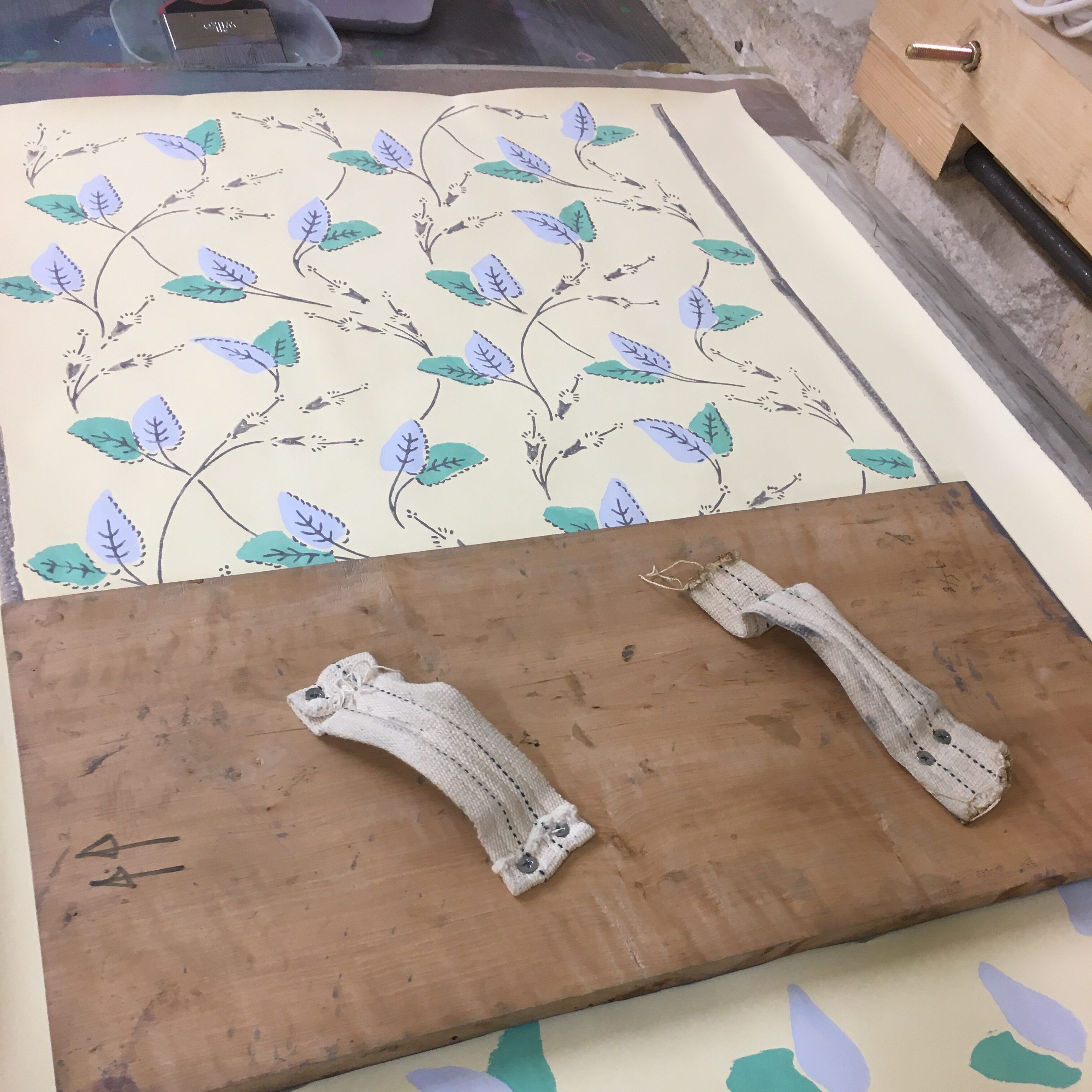
Each sheet of this bespoke wallpaper is produced entirely by hand using authentic pre-1830s techniques that combine block printing with stencil overlays—a sophisticated method requiring considerable skill and precision. The foundation pattern is block printed from a single hand-carved pear wood printing block using an oar press, establishing the primary design structure and tonal depth. The block is carefully inked with hand-mixed distemper paints formulated according to historic recipes using natural pigments and animal glue binders that replicate the characteristic matt finish of early 19th-century wallpapers.
Following the initial block printing, two hand-cut stencils are applied in succession to add additional colours and highlight details, creating the pattern’s characteristic depth and dimensional quality. This multi-layer hand made production method, unchanged since the Regency period, ensures each sheet measures 74.5 x 50 cm and retains the subtle variations and authentic surface character of historic domino papers. The combination of block printing and stencil work demands meticulous registration and colour control across multiple production stages.
Historical Context and Authenticity
Swag and festoon patterns flourished during the late Georgian and Regency periods, reaching peak popularity between approximately 1815 and 1835. These designs reflected the prevailing taste for classical antiquity and the sophisticated drapery motifs found in contemporary textile arts. The Ginsburg Swag’s derivation from period fabric connects it to the broader decorative arts tradition of the era, when wallpaper manufacturers increasingly drew inspiration from furnishing textiles, ceramics, and architectural ornament to satisfy the growing market for coordinated interior schemes.
Original swag wallpapers adorned the walls of prosperous townhouses and country estates throughout the English-speaking world, appearing with particular frequency in drawing rooms, dining rooms, and formal parlours where their architectural character complemented neoclassical plasterwork and furnishings. This historic wallpaper recreation maintains both the technical production methods and the aesthetic sensibilities of circa 1830, ensuring the wallpaper possesses the distinctive surface quality, colour depth, and visual complexity characteristic of authentic late Georgian domino wallpaper.
Bespoke Specifications and Ordering
This block printed wallpaper is produced to order on individual sheets measuring 74.5 x 50 cm (29¼ x 19¾ inches), reflecting period paper manufacturing standards. Pricing is , with a minimum order requirement of Minimum order of 50 sheets covers 18.6 m² = £6500.
All bespoke colour schemes are mixed specifically for each commission to suit your interior requirements. Historic colour palettes for swag patterns typically featured sophisticated combinations—soft stone grounds with blue-grey or sage green festoons, warm cream backgrounds with terracotta or umber drapery, or fashionable French grey schemes with contrasting accents—though contemporary colour interpretations can be accommodated whilst maintaining period-appropriate distemper paint characteristics. Volume orders exceeding 100 sheets receive a 20% discount, making larger projects more economical whilst maintaining uncompromising quality and authenticity.